
Why Are Deck Quotes So Expensive?
Many homeowners are surprised when they request quotes for a new deck. What may seem like a simple outdoor structure can quickly reach tens of thousands of dollars depending on size, materials, and location. A deck may look straightforward from the outside, but building one properly requires structural engineering, quality materials, labor, permits, and careful construction. Understanding where the costs come from helps explain why deck estimates are often higher than expected.
DECK EXPERT TIPS:
Redrra
4/27/20264 min read
Why Are Deck Quotes So Expensive?(And What You’re Really Paying For)
Many homeowners are surprised when they receive quotes for a new deck. What looks like a simple outdoor platform can quickly cost tens of thousands of dollars.
At first glance, it may seem like “just wood and labor.” In reality, a properly built deck is a structural extension of your home, and the cost reflects that.
Understanding what goes into a deck helps you evaluate quotes confidently—and avoid expensive mistakes.
A Deck Is Not Just “Boards Outside"
One of the biggest misconceptions is that a deck is a decorative feature.
In reality, it functions as a load-bearing structure designed to safely support:
People and gatherings
Outdoor furniture
Snow and rain loads
Long-term exposure to weather
A complete deck system includes:
Concrete footings
Structural posts and beams
Joists and ledger connections
Decking boards
Railings and stairs
Structural hardware
Every component must work together. If one fails, the entire structure is compromised.
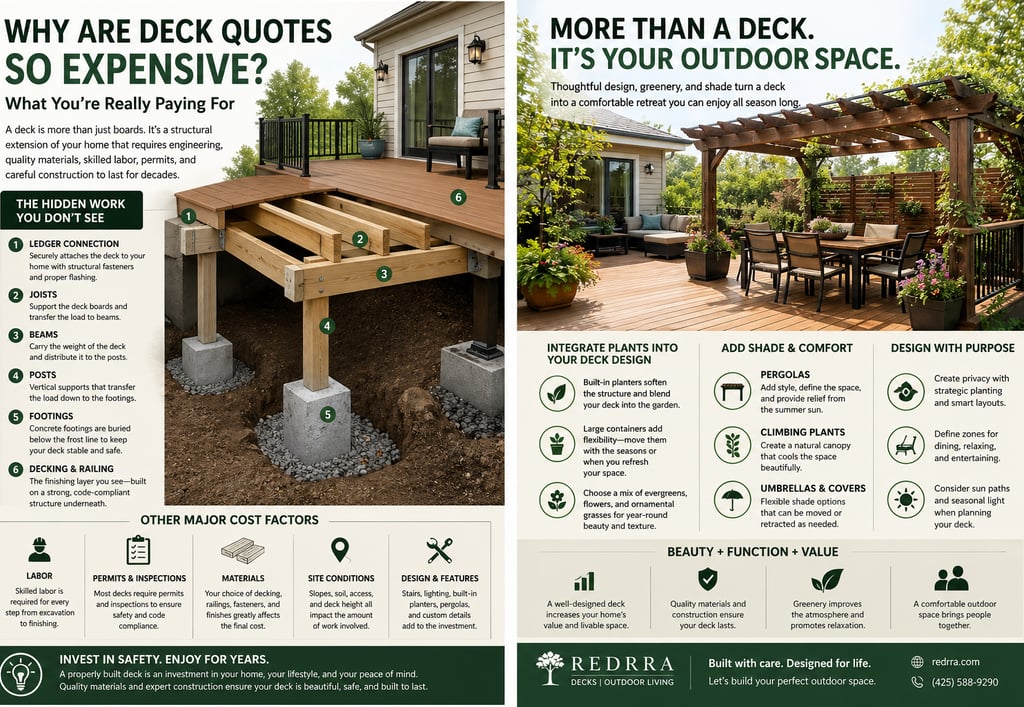
The Most Important Work Is Hidden
What drives cost is not what you see—it’s what’s underneath.
1. Concrete Footings
Footings are the foundation of your deck.
They must be:
Dug below frost depth (critical in Washington State)
Sized according to load requirements
Properly spaced across the structure
Digging, forming, and pouring concrete is labor-intensive and often one of the most expensive phases.
2. Structural Framing
The framing system carries the load of the entire deck.
This includes:
Beams
Joists
Support posts
Spacing, alignment, and fastening must be precise to prevent sagging, bouncing, or long-term failure.
Think of this as the “skeleton” of the deck—you never see it, but it determines everything.
3. Ledger Connection (Critical for Safety)
When a deck attaches to a house, a ledger board connects it structurally.
This step must be done correctly:
Proper flashing to prevent water intrusion
Structural bolts (not just screws)
Code-compliant spacing
This is one of the most common failure points in poorly built decks—and one of the biggest differences between cheap and professional work.
Hardware Is More Advanced Than Most People Think
Modern decks rely on engineered connectors, not just nails.
These include:
Joist hangers
Post anchors
Structural screws and bolts
Corrosion-resistant fasteners
Because pressure-treated lumber contains chemicals, hardware must be specifically rated to avoid corrosion and failure over time.
Cutting corners here might save money upfront—but can lead to serious structural issues later.
Labor Is a Major Cost (And for Good Reason)
Decks are not pre-made products. Every project is built on-site and customized to the property.
That includes:
Excavation and layout
Framing and leveling
Structural fastening
Decking installation
Railing and stairs
Final adjustments and inspection
Each step requires skilled labor.
Unlike interior work, decks also deal with uneven terrain, weather exposure, and structural alignment, which adds complexity.
Permits and Inspections Are Required
Most cities require permits for decks—and for good reason.
They ensure:
Proper footing depth
Structural integrity
Safe railing heights
Correct attachment to the home
Inspections typically happen at multiple stages.
Skipping permits might reduce cost upfront—but creates liability and resale issues later.
Materials Can Dramatically Change the Price
Material selection is one of the biggest price variables.
Pressure-Treated Wood
Lower upfront cost
Requires maintenance (staining, sealing)
Composite Decking
Higher upfront cost
Low maintenance
Longer lifespan (25–50 years)
Premium Hardwoods
High-end look
Expensive material + labor
Beyond decking boards, costs also increase with:
Railings (especially metal or glass)
Lighting
Stairs
Built-in features
Every Yard Adds Its Own Complexity
No two decks are the same.
Costs change based on:
Slope of the yard
Height of the deck
Soil conditions
Accessibility for tools and materials
Design complexity
A simple ground-level deck is very different from an elevated structure with stairs, railings, and multiple support points.
Design Features Add Real Value (and Cost)
What many homeowners don’t realize is that design is part of the investment, not just construction.
Thoughtful additions—like planters, shade structures, and layout flow—can completely change how the space feels and functions.
Integrating Plants Into Deck Design
Instead of treating plants as an afterthought, they can become part of the structure itself.
Well-designed decks often:
Include built-in planter areas
Use large containers to define zones
Blend the deck into the surrounding garden
Plants soften the structure, create privacy, and add movement and texture.
Even simple container layouts can transform a deck from a flat surface into a dynamic outdoor space.
Creating Shade and Comfort
A deck placed in full sun may look great—but can become unusable in summer heat.
Smart designs consider shade early:
Pergolas for structure and visual interest
Climbing plants for natural canopy
Retractable covers or umbrellas for flexibility
A pergola, for example, doesn’t just add shade—it creates vertical structure, defines space, and can increase perceived value significantly.
Flexible vs Permanent Features
Some design elements are permanent, others adaptable:
Built-in planters → permanent structure
Large pots → flexible layout
Pergola → structural feature
Umbrella → movable shade
Balancing both allows homeowners to evolve the space over time without rebuilding.
Why Some Quotes Are Much Higher Than Others
When you compare quotes, the differences can be surprising.
Higher quotes often include:
Stronger structural framing
Better hardware and connectors
Proper permitting and inspections
Experienced labor
Thoughtful design integration
Lower quotes may:
Skip structural details
Use cheaper materials
Avoid permits
Reduce labor time
This is why comparing only the final price is misleading—you need to compare what’s actually included.
Why Even Small Decks Cost So Much
This is one of the most common questions.
Even a small deck requires:
Footings
Framing
Hardware
Labor setup
There’s a baseline cost that doesn’t shrink much with size.
Final Thoughts
A deck is not just an outdoor upgrade—it’s a structural, long-term investment in your home.
The cost reflects:
Engineering and safety requirements
Skilled labor
Material quality
Custom design
Long-term durability
When you understand what goes into the build, the pricing becomes much more logical—and it becomes easier to choose the right contractor.
Your Home, Your Vision, Our Expertise.
Transforming Spaces with Unmatched Craftsmanship
© 2025. All rights reserved.
Proudly Serving Seattle & King County
Bellevue
Redmond
Bothell
Renton
Issaquah
Sammamish
Kenmore
Seattle
Kirkland
Shoreline
Mercer Island
Woodinville
Newcastle
…and many more across King County!