
How to Choose the Right Deck Contractor
A Homeowner’s Checklist for a Safe, Code-Compliant Deck. Building a deck is not just a cosmetic upgrade — it is a structural construction project that directly affects safety, property value, inspections, and long-term maintenance.
Redrra
2/3/20265 min read
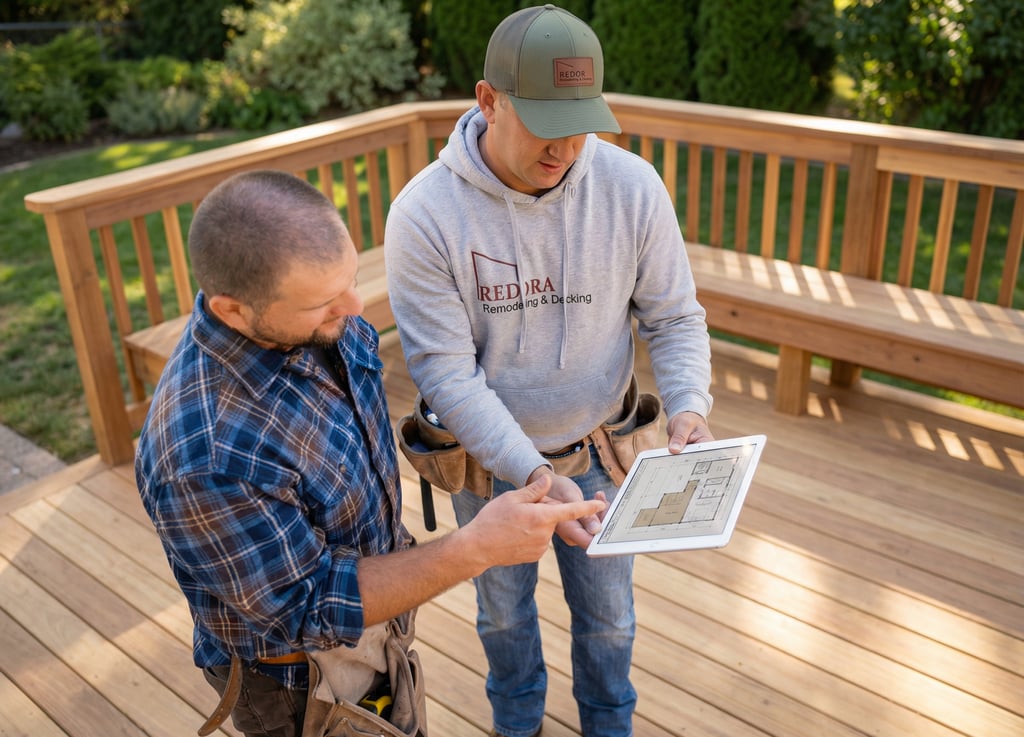
A Homeowner’s Checklist for Seattle, Bellevue, and Sammamish
Building a deck is not just a design upgrade — it is a structural construction project governed by building codes, safety standards, and long-term durability requirements. Choosing the right deck contractor directly affects whether your deck passes inspection, remains safe over time, and protects your investment.
Homeowners in Seattle, Bellevue, and Sammamish face different permit thresholds and local code interpretations, which makes contractor selection even more important. This guide walks you through how to evaluate a deck contractor using real construction principles — not marketing promises.
Why Choosing the Right Deck Contractor Matters
A professional deck contractor should understand:
What legally defines a deck
How local deck codes are enforced
How permits and inspections work in your city
How long a deck should safely last
A contractor who ignores these fundamentals can leave you with failed inspections, unsafe conditions, or the need to rebuild far sooner than expected.
Step 1: Make Sure the Contractor Understands What a Deck Is (By Code)
Before hiring anyone, it’s important to understand that a deck is a defined structural system, not simply an outdoor platform.
The following definition is reproduced verbatim from a professional deck construction reference and reflects how building departments and inspectors view decks:
What is a deck?
A deck is a wood-framed structure located outside of the house.
Other materials may be used for components such as decking, rails, and posts, but the basic structure is made using wood.
A deck may be attached to the house, but a deck is an independent structure except at the point of attachment to the house (if any).
A deck is located at least a few inches above the surrounding ground or other surface outside of the house.
Why This Matters
A deck contractor must treat your project as structural construction, not surface carpentry. Framing, attachment to the house, footings, guardrails, and load paths all matter. If a contractor downplays these elements, that is a warning sign.
Question to ask:
How do you design and frame decks to meet structural and code requirements?
Step 2: Confirm Licensing, Bonding, and Insurance
Any contractor building a deck should be:
Licensed in Washington State
Bonded
Fully insured (general liability and workers’ compensation)
Decks are inspected structures. If something goes wrong and the contractor is not properly licensed or insured, the homeowner may be exposed to liability or denied insurance coverage.
Question to ask:
Can you provide your contractor license number and proof of insurance?
Step 3: Ask Who Handles Permits and Local Deck Codes
Deck codes are not the same everywhere. While most jurisdictions follow the International Residential Code (IRC), local governments adopt their own versions and amendments.
The following explanation is reproduced unchanged to illustrate how deck codes vary across jurisdictions:
Almost all areas of the United States have adopted some version of a building code. Some states, such as California, Florida, North Carolina, and WA, have a state building code. Some large cities, such as Chicago and Seattle, have a city building code.
Many of these state and local building codes are based on the model codes from the International Code Council (ICC). Smaller cities and counties often use ICC model codes, such as the IRC. Some rural areas may not have adopted a building code, but this is becoming an uncommon situation.
Most building departments that use the IRC adopt local changes to the code. Many of these changes are minor and help to adapt the IRC to local conditions and needs. Some of these changes significantly alter IRC provisions.
Codes and standards vary between jurisdictions. This variability includes how and when codes and standards are interpreted and enforced.
What This Means for Homeowners
A deck that passes inspection in one city may fail in another. A qualified contractor should handle permits and inspections and understand how local codes are enforced.
🚩 Red flag:
A contractor who says, “You don’t need a permit,” without reviewing deck height, attachment, or location.
Local Permit Considerations: Seattle, Bellevue, and Sammamish
Seattle
In Seattle, a construction permit is generally required for decks that are:
More than 18 inches above ground, or
Attached to the house
Seattle also enforces zoning, lot coverage, and setback rules that may affect deck size and placement. A contractor should be familiar with Seattle Department of Construction & Inspections (SDCI) requirements and inspection procedures.
Bellevue
In Bellevue, permits are typically required for:
Decks attached to the home
Decks 30 inches or more above grade
Decks may also require additional review if they include electrical components such as lighting or outlets.
Sammamish
Sammamish requires permits for any structural deck work, including framing and railings. Decks taller than 18 inchesare subject to lot coverage and setback calculations, which makes accurate planning critical.
Question to ask:
Do you regularly pull permits and pass inspections in my city?
Step 4: Review Experience With Your Specific Deck Type
Not all decks are the same. Ask about experience with:
Composite vs. wood decking
Elevated or multi-level decks
Guardrails and stairs
Sloped or challenging sites
Decks must meet structural load and safety requirements regardless of appearance.
Question to ask:
Have you built decks similar to mine that passed inspection?
Step 5: Understand Deck Service Life and Safety
A professional contractor should understand not only how to build a deck, but how long it should safely last.
The following explanation is reproduced verbatim for accuracy:
The service life of a deck can be divided into two categories. One category is the service life of the deck components, such as the wood and the fasteners. The other category might be called functional obsolescence.
Deck component service life varies over a wide range that depends on factors including environmental conditions and maintenance. The range varies from as little as 5 to 10 years for a deck located directly on the ocean to as many as 25 years for a well-maintained deck in a dry environment, such as a desert.
A common estimate for the service life of an average deck, in an average environment, with average maintenance, is between 10 and 20 years.
Why This Matters
A deck can appear solid while still being unsafe due to outdated standards or aging components. A responsible contractor should be able to advise whether repair, reinforcement, or full replacement is the safest option.
Question to ask:
Is my deck still within its safe service life?
Step 6: Require a Clear, Written Scope of Work
A professional estimate should clearly list:
Materials (brand, type, grade)
Deck size and layout
Railings, stairs, and accessories
Permit and inspection handling
Timeline and milestones
Avoid estimates that provide only a single total price without detail.
Deck Contractor & Hiring Questions
How do I know if a deck contractor is legitimate?
A legitimate deck contractor should be licensed, bonded, insured, and able to provide recent local references. They should also be willing to explain how permits and inspections will be handled.
How many deck quotes should I get before choosing a contractor?
Most homeowners compare two to three detailed quotes. The key is not the lowest price, but the clearest scope of work and strongest understanding of local codes.
Is it a red flag if a contractor says a permit is not required?
Yes. While some very low decks may not require permits, most decks in Seattle, Bellevue, and Sammamish do. A contractor should review your deck’s height, attachment, and location before making that claim.
Should a deck contractor handle permits and inspections?
Yes. Professional deck contractors typically handle permit applications, inspection scheduling, and code compliance as part of the project.
Your Home, Your Vision, Our Expertise.
Transforming Spaces with Unmatched Craftsmanship
© 2025. All rights reserved.
Proudly Serving Seattle & King County
Bellevue
Redmond
Bothell
Renton
Issaquah
Sammamish
Kenmore
Seattle
Kirkland
Shoreline
Mercer Island
Woodinville
Newcastle
…and many more across King County!