
How Long Will Composite Decking Last?
Discover how long composite decking lasts, what affects deck lifespan, and why homeowners choose composite materials for low-maintenance outdoor living spaces. Learn expert insights from Redrra.
DECK EXPERT TIPS:DECK ADVICE
Redrra
5/15/20263 min read
How Long Will Composite Decking Last?
What Homeowners Should Know Before Investing in a New Deck
Composite decking has become one of the most popular choices for modern outdoor living spaces — especially for homeowners looking for long-term durability, lower maintenance, and a clean architectural appearance.
One of the most common questions homeowners ask before starting a project is:
How long will composite decking actually last?
The answer depends on several factors, including the quality of materials, structural framing, installation methods, climate exposure, and long-term maintenance.
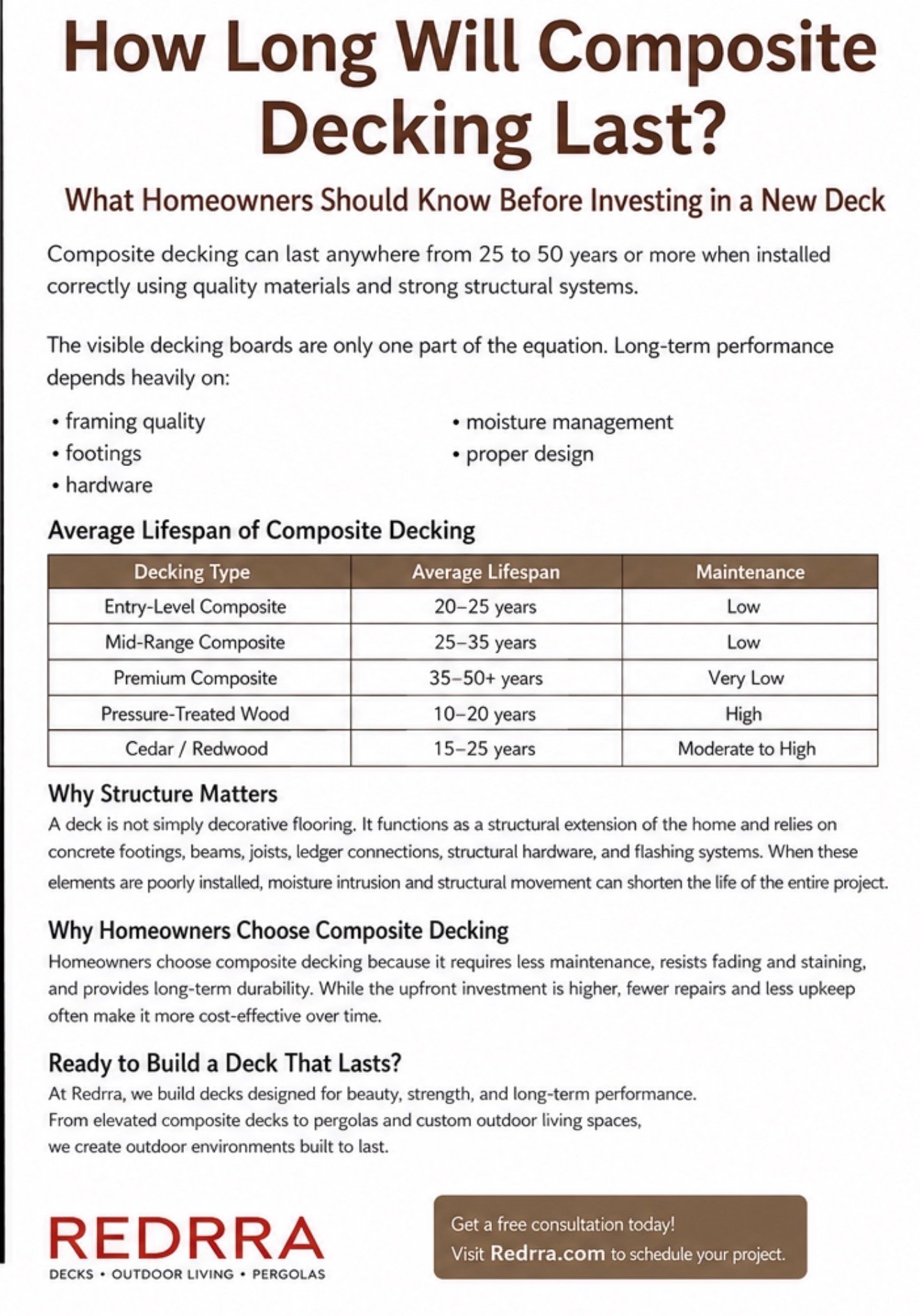
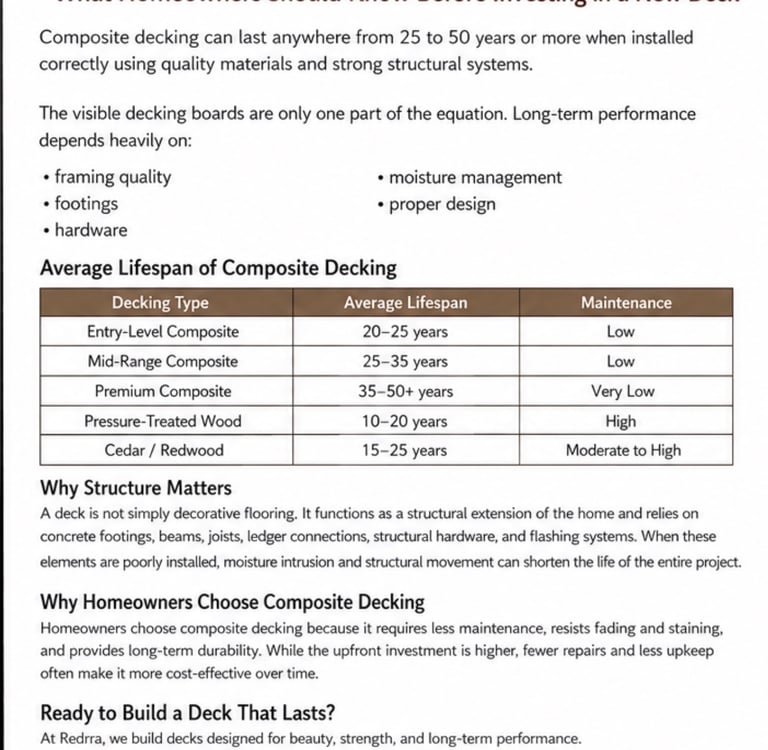
In most cases, high-quality composite decking can last anywhere from 25 to 50 years or more when installed correctly on a properly built structural system. However, the visible decking boards are only one part of the equation.
A deck is not simply decorative flooring. It functions as a structural extension of the home and relies on framing systems, concrete footings, hardware connections, moisture management, and proper engineering to achieve true long-term performance.
At Redrra, we help homeowners understand not only the appearance of a deck project, but the structural decisions that determine how the deck performs over decades.
Composite Decking vs Traditional Wood
Traditional pressure-treated wood decks remain common because of their lower upfront cost, but wood requires significantly more maintenance over time.
Wood decks are vulnerable to:
moisture absorption
cracking
splintering
warping
insect damage
fading
staining deterioration
Composite decking was developed to reduce many of these issues.
Most premium composite products are manufactured using recycled wood fibers and polymers engineered to resist moisture, UV exposure, insects, and rot.
Unlike wood, composite decking does not usually require:
annual staining
sanding
sealing
repainting
This lower-maintenance approach is one of the primary reasons homeowners choose composite materials despite the higher upfront investment.Average Lifespan of Composite Decking
The lifespan of composite decking varies depending on product quality and installation
Premium capped composite decking systems typically offer the longest lifespan because they include protective outer layers that resist:
moisture penetration
fading
staining
mold growth
scratching
Some manufacturers also provide structural or fade warranties extending 25–50 years.
The Structure Below the Deck Matters More Than Most Homeowners Realize
One of the biggest misconceptions in deck construction is assuming the decking boards determine the lifespan of the project.
In reality, the structural system beneath the deck is often more important than the visible surface itself.
A properly built deck relies on:
concrete footings
structural beams
joists
ledger connections
flashing systems
corrosion-resistant fasteners
moisture management
framing layout
If these components fail, even the most expensive composite boards cannot protect the deck from structural deterioration.
This principle has been emphasized by professional deck designers for decades.
As noted in professional deck design literature, superior deck construction involves not only aesthetics but also “engineering and craftsmanship,” requiring “good footings and strong framing, and careful joinery and attention to detail.” That philosophy still applies today.
Why Professional Installation Matters
Even premium composite materials can fail prematurely if installed incorrectly.
Improper installation may lead to:
trapped moisture
structural movement
improper board spacing
drainage problems
framing deterioration
loose railings
sagging surfaces
Professional installation becomes especially important in climates with significant moisture exposure, including the Pacific Northwest.
At Redrra, we pay close attention to:
framing spacing
ventilation beneath the deck
flashing systems
drainage flow
hardware compatibility
expansion gaps
long-term structural movement
These details significantly affect how long a deck performs safely and maintains its appearance.
Moisture Management Is Critical
Many homeowners assume composite decking is completely waterproof.
While composite materials resist moisture far better than traditional wood, water management still plays a major role in deck longevity.
Moisture problems often originate from:
poor drainage
trapped debris
improper ledger flashing
standing water
inadequate ventilation beneath the deck
Professional deck planning often incorporates landscaping and airflow considerations as part of the design process.
Older architectural deck planning references frequently emphasized integrating planting areas, shade structures, and airflow into deck layouts to create more natural moisture balance and improve long-term comfort.
Modern outdoor living design continues to use many of these same concepts today.
Composite Decking Performs Well in Modern Outdoor Living Spaces
One reason composite decking has become increasingly popular is its compatibility with modern outdoor living design.
Today’s decks are no longer simple rectangular platforms attached to the back of a house.
Many homeowners now incorporate:
pergolas
integrated lighting
curved deck layouts
outdoor kitchens
built-in seating
planter systems
shade structures
multi-level entertaining spaces
Professional deck designers have long recognized that outdoor structures should blend architecture, landscape, and usability together.
Older custom deck concepts often incorporated:
curved transitions
pergola structures
integrated planters
layered elevations
seating zones
overhead shade features
These design ideas remain highly influential in modern luxury deck construction.
Composite materials are particularly effective for these environments because they maintain a cleaner appearance over time with less maintenance.
Can Composite Decking Fade?
Modern composite decking products resist fading much better than earlier generations.
However, some gradual color change over time is still normal, especially during the first several months after installation.
Premium capped composites typically provide:
UV protection
stain resistance
fade resistance
scratch resistance
Lighter colors often perform better in direct sunlight because they absorb less heat.
Does Composite Decking Get Hot?
Composite decking can become warmer than natural wood in direct sun exposure, particularly with darker colors.
Heat retention depends on:
color selectionsun exposure
ventilation
regional climate
Many homeowners reduce heat buildup by incorporating:
pergolas
shade canopies
umbrellas
partial cover structures
strategic landscaping
Outdoor design planning books have historically emphasized shade integration as an important part of deck usability, especially in warmer months when direct sunlight can make outdoor spaces uncomfortable.
Modern pergola systems continue to serve both functional and architectural purposes by helping regulate sunlight while enhancing visual appeal.
Is Composite Decking Worth the Cost?
Composite decking usually costs more upfront than pressure-treated wood.
However, many homeowners find the long-term value worthwhile because of:
reduced maintenance
longer lifespan
lower repair frequency
improved appearance retention
reduced staining
Your Home, Your Vision, Our Expertise.
Transforming Spaces with Unmatched Craftsmanship
© 2025. All rights reserved.
Proudly Serving Seattle & King County
Bellevue
Redmond
Bothell
Renton
Issaquah
Sammamish
Kenmore
Seattle
Kirkland
Shoreline
Mercer Island
Woodinville
Newcastle
…and many more across King County!