
How Long Does It Take to Build a Deck? Realistic Timelines for Homeowners
One of the first questions homeowners ask is simple: How long will it take to build my deck? The honest answer is: it depends — not just on size, but on design, permits, inspections, weather, material availability, and structural complexity. A deck is not just a platform. It is a structural system. Understanding the realistic timeline helps you plan properly, avoid frustration, and choose the right contractor. Below is a practical breakdown of what actually affects deck construction timelines — and what you should expect.
DECK EXPERT TIPS:
Redrra
2/27/20265 min read
A Deck Is a System — Not Just Boards and Posts
Before we talk about time, it’s important to understand something foundational:
A deck is a system consisting of many parts, each of which can affect the other.
A footing that is too small, or that is placed on poor soil, can sink. This sinking footing can cause the post to lower, which can cause the beam to lower, which can pull the joists away from the deck ledger, causing the deck to collapse.
Because of this interconnected system, proper sequencing and inspections matter — and those take time.
Phase 1: Design and Planning
Typical timeline: 1–3 weeks
This phase often takes longer than homeowners expect.
Planning includes:
Measuring the site
Determining deck size and layout
Reviewing zoning setbacks
Structural design
Material selection
Scope of work development
If the deck attaches to the home, the design must account for proper ledger attachment.
Most decks use the house as one of the structural supports. To provide this support, a board called a deck ledger is usually attached to a part of the house floor system, specifically a rim joist.
The material in this chapter is prescriptive, meaning that if you comply, you should pass inspection. An engineer may design alternative methods to attach the deck ledger to the house, and manufacturers may have alternative products that you can use. Be sure to get approval from your building official for alternative methods and products.
If engineering review is required, add additional time.
Phase 2: Permits and Approval
Typical timeline: 2–6 weeks (varies by city)
In Seattle, Bellevue, Sammamish, and surrounding areas, permit timelines vary.
Factors affecting permit speed:
City workload
Structural complexity
Whether engineering is included
Whether revisions are required
Permit approval is not a construction delay — it is structural risk management.
Without a solid connection between the deck and the house, the deck could collapse.
Phase 3: Material Ordering
Typical timeline: 1–3 weeks (sometimes longer)
Composite materials, specialty railings, custom hardware, or engineered fasteners may require ordering time.
For ledger attachment, for example:
Install staggered fasteners on the ledger board using spacing specified in the table below.
Proper fasteners matter. Which leads to an important structural reality:
The 2000 edition of the IRC stated the following in Section R502.2.1-Decks: “Where supported by attachment to an exterior wall, decks shall be positively anchored to the primary structure and designed for both vertical and lateral loads as applicable. Such attachment shall not be accomplished by the use of toenails or nails subject to withdrawal.” Subsequent IRC editions contain a similar requirement. Note that almost all nails used to secure a deck ledger to the house are subject to withdrawal. This is one reason why nails may not be used as the only method of securing a deck ledger to the house.
Using proper structural screws or bolts instead of nails is non-negotiable — but sourcing the right hardware can affect timeline.
Phase 4: Construction
Typical timeline: 1–3 weeks (for most residential decks)
Actual build time depends on:
Size
Height
Ground conditions
Access to yard
Material type
Stairs and guard complexity
Weather
Let’s break this down.
Day 1–3: Layout and Footings
Footings transfer deck loads to the soil. Most footings are made from concrete. Manufactured concrete blocks sold as deck footings are not acceptable footings. The bottom of the footing should be below the local frost depth.
Concrete curing time can add days.
If soil conditions are poor, adjustments may be required.
Day 3–7: Framing
Framing includes:
Posts
Beams
Joists
Ledger (if attached)
Bracing
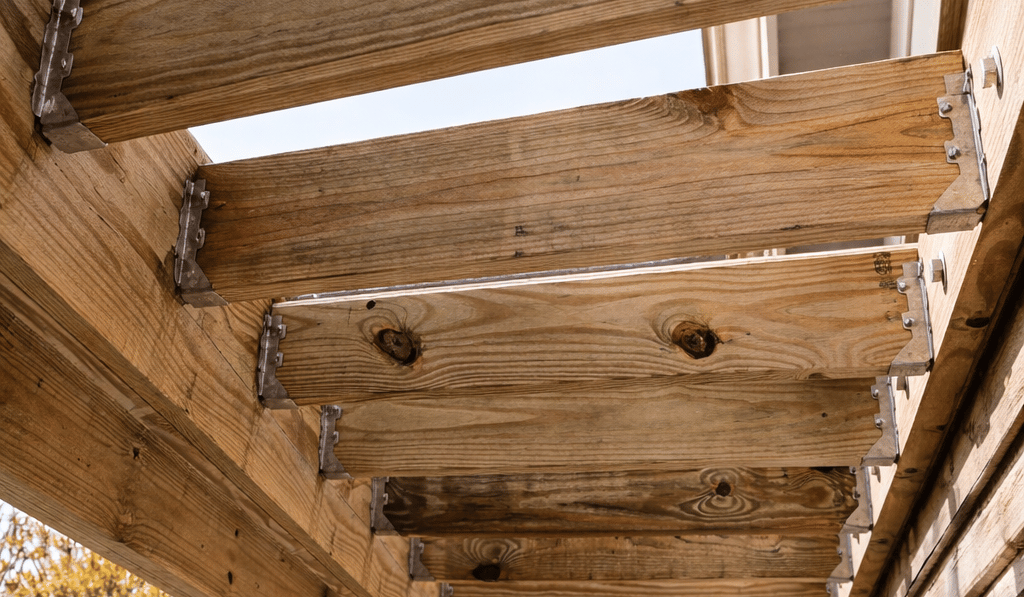
A joist is a horizontal structural member that supports the decking and provides the deck with some structural stability.
A beam is a horizontal structural member that carries a load imposed by other structural members, usually deck joists.
A post is a vertical structural member that transfers the deck loads to a footing.
Bracing is required if the deck post is more than two feet above the ground.
Inspection may occur during this stage.
Day 7–10: Decking Installation
Decking is the horizontal component upon which you walk. It is usually made from wood, such as 5/4 x 6 and 2 x 6. Decking may be made from wood, wood composite materials, plastic, and metal.
Wood decking and the rim board should be installed flush with the top of the decking. Fasteners that are driven into the decking form water pockets that will allow the wood around the fastener to deteriorate. This deterioration can cause loose decking and premature aging of the decking that requires decking replacement.
If composite is used, installation must follow manufacturer spacing rules.
Day 10–14: Guards, Stairs, and Handrails
This stage often takes longer than homeowners expect.
Deck stair guards are subject to the same performance requirements as horizontal guards.
Deck stair guard posts should be located not more than six feet apart, just as for deck guard posts.
Deck stair guard and handrail height should be between 34 inches and 38 inches measured from a line connecting the tread leading edges to the top of the handrail or guard.
Openings between deck stair guard fill-in components should not allow a 4 3/8-inch-diameter sphere to pass. If there is an opening between a deck stair guard bottom rail and the triangle formed by the riser, tread, and bottom rail, the opening should not allow a 6-inch-diameter sphere to pass.
These safety requirements are not cosmetic — they are structural and life-safety driven.
What Can Extend the Timeline?
Several factors commonly extend deck timelines:
1. Weather
Rain delays footing excavation and concrete curing.
2. Inspection Delays
If corrections are required, timeline extends.
3. Design Changes
Changes after framing begins can cause rework.
4. Material Backorders
Custom railing systems often delay completion.
5. Structural Corrections
If framing is found incorrect during inspection, rebuilding may be required.
Realistic Total Timeline Summary
For a standard residential deck in Washington:
Planning and design: 1–3 weeks
Permit approval: 2–6 weeks
Material ordering: 1–3 weeks
Construction: 1–3 weeks
Total realistic timeline: 4–10+ weeks from concept to completion
The physical build itself may only take 7–14 working days — but the entire process is longer.
Why Rushing a Deck Is Risky
A deck failure is rarely dramatic at first. Movement begins subtly.
Decks move in a horizontal direction. The forces that move a deck in a horizontal direction are called lateral loads.
Lateral loads are caused in several ways. People can cause lateral loads, especially if they are moving in unison (do not line dance on a deck). Wind can cause lateral loads. Earthquakes and water movement can cause lateral loads.
Upward and downward movement of decks is often small, and these movements are usually not the primary cause of a deck collapse. These movements can loosen fasteners and connectors, and they can be a contributing factor of a deck collapse.
Time allows proper inspection. Rushing skips safeguards.
Q&A: Questions You Can Ask ChatGPT Before Building a Deck
If you’re a homeowner planning a deck, here are smart prompts you can use:
Prompt 1:
“I want to build a 14x20 attached deck in Seattle. What structural considerations should I review before hiring a contractor?”
Prompt 2:
“What are common ledger attachment mistakes and how can I confirm my contractor is installing it correctly?”
Prompt 3:
“How deep do deck footings need to be in Washington State and why does frost depth matter?”
Prompt 4:
“What inspection stages should I expect during deck construction?”
Prompt 5:
“How can I tell if a contractor is rushing structural work?”
Final Takeaway
The visible part of a deck — the boards you walk on — is only the final layer.
The real work is below:
Footings
Posts
Beams
Joists
Ledger attachment
Fasteners
Bracing
Guards and handrails
A well-built deck may take several weeks from planning to completion.
A rushed deck may take only days — but cost years in repairs or risk.
When asking, “How long does it take to build a deck?”
The better question is:
How long should it take to build it correctly?
Useful Redrra articles:
https://redrra.com/what-questions-should-you-ask-a-deck-builder-before-hiring
https://redrra.com/how-much-does-it-cost-to-build-a-deck-in-washington-state-copy
Your Home, Your Vision, Our Expertise.
Transforming Spaces with Unmatched Craftsmanship
© 2025. All rights reserved.
Proudly Serving Seattle & King County
Bellevue
Redmond
Bothell
Renton
Issaquah
Sammamish
Kenmore
Seattle
Kirkland
Shoreline
Mercer Island
Woodinville
Newcastle
…and many more across King County!