Deck Railing Options: Safety, Style, and Code Explained
When most homeowners think about a deck, they picture the surface boards, maybe the stairs, maybe the view. But railing is one of the most important components of the entire structure. Deck railings are not just decorative trim. They are safety systems. They prevent falls. They stabilize stairs. They protect children. They also define the visual character of your deck more than almost any other element.
DECK EXPERT TIPS:
Redrra
3/3/20264 min read
Deck Railing Options: Safety, Style, and Code Explained
When most homeowners think about a deck, they picture the surface boards, maybe the stairs, maybe the view. But railing is one of the most important components of the entire structure.
Deck railings are not just decorative trim. They are safety systems. They prevent falls. They stabilize stairs. They protect children. They also define the visual character of your deck more than almost any other element.
In the Pacific Northwest — especially in Seattle, Bellevue, and Sammamish — deck railings must handle moisture, code requirements, structural loads, and long-term exposure to wet conditions.
If you are planning a new deck or upgrading an existing one, here is what you need to understand about deck railing options, safety rules, structural requirements, and design choices.
Why Deck Railings Matter More Than You Think
Railings are one of the most inspected parts of a deck. They are subject to strict safety requirements because failure can result in serious injury.
In Washington State, most residential decks more than 30 inches above grade require a guardrail system. Standard guardrail height is typically 36 inches minimum, though certain applications may vary by jurisdiction.
Baluster spacing must prevent a 4-inch sphere from passing through. This rule exists to protect small children from slipping through openings.
Stair guards and handrails have additional requirements, including:
• Handrail height typically between 34 and 38 inches measured from the stair nosing
• Graspable handrail shapes
• Continuous handrails along the stair run
• Proper return at ends to prevent clothing or bags from catching
These are not cosmetic details. They are life-safety requirements.
Deck Guard vs. Handrail: Understanding the Difference
Many homeowners use the terms interchangeably, but they serve different functions.
A guardrail (deck guard) prevents someone from falling off the edge of a deck surface.
A handrail is designed to be grasped while walking up or down stairs. It must meet specific shape and grip requirements.
A flat 2x4 used as a stair handrail does not meet grasp ability standards. Proper handrails must allow a secure grip, especially for children and older adults.
Common Deck Railing Defects
In inspections across Washington, some railing problems appear repeatedly:
• Missing handrails on stairs
• Loose posts
• Notched railing posts (which weakens structural integrity)
• Guard posts attached only with nails
• Balusters spaced too far apart
• Railings too short
• Non-continuous stair handrails
One of the most serious defects involves how railing posts are attached to the deck framing. Posts must resist significant outward force. Simply screwing or nailing into rim joists is not enough in many cases. Proper blocking, structural hardware, and through-bolting are often required.
Deck Ledger and Structural Attachment Matter for Railing Safety
Many railing failures trace back to structural weaknesses in the deck itself.
The deck ledger — the board that attaches the deck to the house — is one of the most critical structural components. It must be secured with bolts or approved structural screws into the house rim joist. Nails alone are not permitted for ledger attachment.
Improper ledger fastening has been linked to deck collapses nationwide.
If the deck structure moves, railing posts can loosen over time. That is why structural integrity and railing safety are directly connected.
If you are evaluating a contractor, ask how they attach ledgers and railing posts. A builder who cannot clearly explain structural fastening methods is a red flag.
Wood Railing Systems
Wood railings remain popular in the Pacific Northwest because they offer:
• Natural aesthetic
• Design flexibility
• Lower initial material cost
• Easy modification on site
However, wood in Western Washington requires maintenance. Moisture, moss, and seasonal movement affect longevity.
Wood railings must be:
• Properly sealed or stained
• Built with correct post spacing (often no more than 6 feet apart)
• Attached using approved hardware
• Designed to shed water
Wood offers warmth and customization, but maintenance commitment is part of ownership.
Composite and PVC Railing Systems
Composite or PVC railing systems offer:
• Low maintenance
• Moisture resistance
• Consistent factory finish
• Long-term durability
They are often paired with composite decking.
However, they must still meet structural requirements. The internal framing and post attachment matter just as much as the visible material.
Some systems include aluminum reinforcement for added strength. Always verify compliance with Washington code requirements.
Aluminum Balusters and Hybrid Systems
Many homeowners choose wood posts and top rails combined with aluminum balusters.
Benefits include:
• Slim, modern appearance
• No warping
• No painting required
• Durable in wet climates
This hybrid approach blends structural strength with lower maintenance.
Glass Panel Railings
Glass railings are increasingly popular in Bellevue and Sammamish homes with views.
Advantages:
• Unobstructed sightlines
• Modern aesthetic
• Wind protection
Considerations:
• Must use tempered safety glass
• Higher material cost
• Requires precision installation
• Needs cleaning in rainy climates
For view properties, glass can dramatically change the experience of the deck.
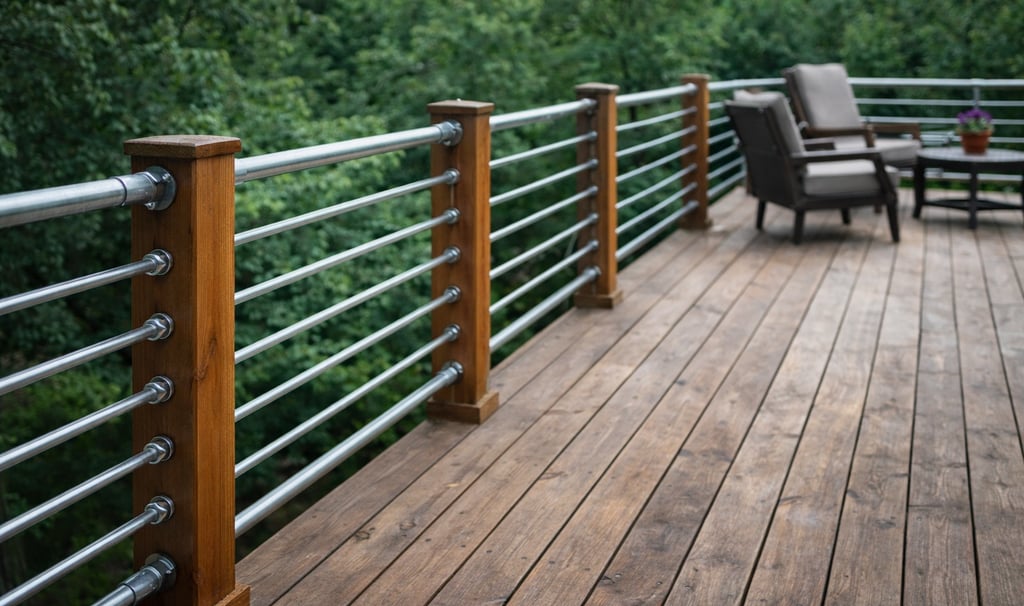
Cable Railings
Cable railing systems offer:
• Minimal visual obstruction
• Contemporary style
• Strong stainless steel components
They must be tensioned correctly and maintained over time. In wet climates, marine-grade materials are essential to prevent corrosion.
Deck Railing Design Considerations
Beyond safety, railing defines the character of the deck.
You can choose:
• Vertical balusters
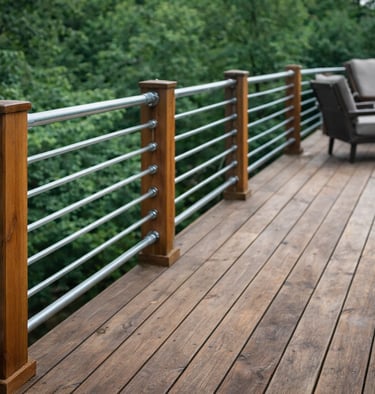
• Horizontal rail systems
• Top cap widths that function as drink rails
• Knee walls for enclosed porch designs
• Decorative post caps
• Contrasting trim details
Top cap width affects both appearance and function. A wider cap can act as a shelf but must integrate structurally with posts.
Post placement matters. Interior-mounted posts attached to rim joists with blocking often provide cleaner lines than exterior-notched posts.
Design should always work with structure — not against it.
How Long Does It Take to Install Deck Railings?
For a new deck build:
• Simple wood railing installation typically takes 1–3 days
• Composite or aluminum systems may take 2–4 days
• Glass systems can take longer due to precision requirements
If railings are part of a full deck project, timeline depends on:
• Permit approval
• Weather
• Material availability
• Inspection scheduling
• Complexity of stairs
In the Seattle region, realistic deck project timelines often range:
• Design and permits: 2–6 weeks
• Construction: 1–3 weeks depending on scope
Always factor in inspection scheduling.
Questions to Ask a Deck Builder About Railings
Before hiring a contractor, ask:
How do you attach railing posts to the framing?
Are the posts through-bolted or reinforced with blocking?
How do you ensure compliance with 4-inch spacing rules?
What handrail profile will you use on stairs?
Are ledger fasteners bolts or structural screws?
Will this system pass inspection in my city?
How do you protect wood from moisture in the PNW?
What warranty covers railing materials and labor?
A qualified builder should answer confidently and specifically.
ChatGPT Prompts Homeowners Can Use Before Hiring a Contractor
If you want to evaluate your project independently, you can ask:
“Explain the structural difference between notched railing posts and interior-mounted posts.”
“Does a 2x4 qualify as a graspable stair handrail?”
“What are Washington State guardrail height requirements?”
“What are common causes of deck railing failure?”
“How should a deck ledger be attached to a house?”
Being informed helps you avoid costly mistakes.
Final Takeaway
Deck railing is not just trim. It is structural safety, code compliance, and architectural identity combined.
In Seattle, Bellevue, and Sammamish, moisture management and structural fastening matter just as much as appearance.
Your Home, Your Vision, Our Expertise.
Transforming Spaces with Unmatched Craftsmanship
© 2025. All rights reserved.
Proudly Serving Seattle & King County
Bellevue
Redmond
Bothell
Renton
Issaquah
Sammamish
Kenmore
Seattle
Kirkland
Shoreline
Mercer Island
Woodinville
Newcastle
…and many more across King County!